Howdy Paul:
Thanks for your response. To answer your first question, I tip the scales at 15 stone, or 95.2543977 kilos. (210 lbs.) That will change next time I pee!

I'm not too concerned about racing classes. Where I sail, the most boats I've ever seen at one time was about nine. I want to go relatively fast, but light air sailing is even more inportant in that we travel seven hours to the playa, and it is too much of an investment to sit around in moderate wind waiting for it to get up to 12-15 mph. (19.3121-24.1402 kph) Where the PM's and Manta's get started.
I'm curious to know how many skis were laminated to form the axle which you thought would not be effective. I have found that to be similar to the flex in the Manta twin axle, three skis are required.
Relative to the question about angling the axles forward or rearward and the toe-in/out question: Is there a component of axle flex that contributes to instability in the forward design when bicycling? I can't see how rotating either of these tricycle designs on their long axis would create toe-in/out.

My main interest in angling the axles forward is to get my body weight over the contact point of the rear wheels to avoid the constant "crabbing" and regular "twitchiness" that I get with the Manta in the 80 kph range.
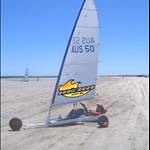
I'm going to attempt to add a couple of images. The Manta Twinjammer has been modified to change the canvas twin seat to a rotomolded bucket, it is otherwise box stock. I now call it a "Twingle". It was moving in the high 70 kph range in this photo.
If you go to Google Earth and navigate to 42 degrees 30' 25.61" N and 118 degrees 31' 48.66 W you will have arrived at our normal campsite. You can then scan around for views of the playa, the hot springs etc.
Here is a little slide show made with a free site I found:
http://www.photoshow.com/watch/WG5Nc6ii 
Enough for now. Hey...Good on 'ya for a GREAT competition in Olympic swimming!
Perry

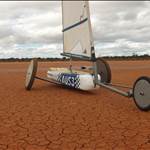
 . The hull is a very aerodynamically slippery river kayak, shortened and reinforced. The front wheel and forks are from a 50 cc pocket bike. There is a very sexy looking 4" disc brake which I fancy because in the hull I can't brake with me feet when returning to camp. Rear wheels are Dunlop "mags" and tires at 3.50 x 8; beach wheels from a Zodiac inflatable. The rear axles are made from laminated downhill racing skis. The tips are removed and the tails cut off to provide two four foot units which are springy yet quite stable and only slightly heavier than optimum.
 . Im looking at one right now( yes , in Kalgoorlie) and I wouldnt bother on a 5 sized yacht. other than that do what the others have suggested.
 . That's a very strong committment there Perry but by the looks of your slide show very well worth it.

 are using sail board masts in addition to those incredibly heavy vertical ballast made of steel.