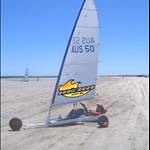
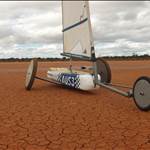
The sandpiper steering was "light" mainly because the seat was leaning back a fair bit and this reduced the weight on the front axle but it steered quite nicely .. untill we added the jib...then in high winds and a soft surface it wouldn't turn at all. We even tried horizontal wings on the front forks to keep it down at speed (didn't work) the best way to turn in high winds was lean forward a bit, slacken off the jib then turn.
For more info on wheel caster ...
en.wikipedia.org/wiki/Caster_angle Bike bits sometimes are ok..you might be better just getting the upper and lower bearings and the cups they run in and sit them into a piece of tube ( this is what the sandpiper used)
Just another point in using bike wheels, have a read of the class 5 rules....
"WHEELS, There will be two non-steerable rear and one steerable front wheel. The overall diameter of the tyre shall not exceed 650 mm. Wire spoked wheels are allowed provided the spokes are protected by covers on both sides."Mind you for a Class 6 bike wire spoke wheels work fine as a front wheel but they collapse as rear wheels , Plastic bike wheels are stronger BUT the tyres
will roll off at high speed ..
"been there done that!!!" A thought in the design of "this" Class 5 was to use a clamp on the main spine tube for front end. This would enable changing to a roll over front end with just a few bolts if you wanted to ... even between races!!
This is also the reason that the rear wheels have zero camber (ie. straight up and down), this enables a change in the main spine angle to the ground, without re-aligning the rear wheels.
To the people that have asked....the CAD program used is avaliable FREE from
www.cadstd.com/Its a simple FREE Cad program and works very well, still not as creative as a pencil on the back of a beer coaster but the results from the Cadstd are GREAT.



 or HYPERACTIVE

 Now I just have to decide if I put them on my PM or save them for my next project??