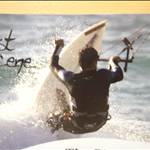
Here's a couple of shots of both an epoxy - tuflight and conventional fiberglass shortboard I converted.
Both boards get hammered under heel and along the rails on the right side of board, as most of my boosting is done goofy. I'm constantly repairing them and am currently working with a shaper to design a board that might handle the pressures of kiting but still be light enough to surf.
The conventional fiberglass board is my fav, I added another 2 layers of 6 oz matting to the deck and 1 to the bottom and re-inforced the rails under foot, and sunk in foot strap plugs. It's heavier than the epoxy but I could surf the epoxy as a normal shortboard, although I dont because I put full deck-grip on the board because of heel indents. So epoxy's will still be prone to heel indents.
Most of the shapers I've spoken to reckon I should just have a kiteboard, not an all-rounder, standard kiteboard (glass/carbon fiber) is 2 layers of 6oz on the bottom and 3 layers of 6 oz on the deck plus the heels/toes reinforcement - which will result in a board that is heavy compared to a normal surfboard.
I'm looking at working with a shaper to design a conventional fiberglass shortboard with carbon-fiber reinforcements under heel, along the rails, fin plugs (FCS) and strap inserts. Hopefully it can be the one board quiver? light enough to surf but strong enough to kitesurf.
When you pay on average $650 > for one of these things, you want to be sure it's not going to snap first session, the only guaranty a shaper can give you is; no refunds.