A slightly different perspective:
Some joggers spend big bucks on fancy shoes and still get knee pain, whilst others are fine running in any old things. The difference (prior injuries and conditions aside) is in how they co-ordinate themselves as they run. (I teach runners and other athletes, dancers etc. from beginners to elite competitors.)
Other examples are Kelly Slater and Roger Federer. They've each had long careers with very few injuries because they move so well. They expend effort more efficiently than their peers, achieving greater power and less injury by co-ordinating themselves well.
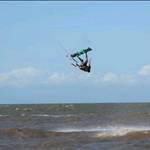
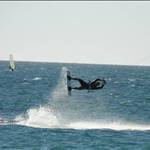
As I observe other kiters, there are big differences in overall strategies/approaches to landing, as well as differences in the subtler ways of co-ordinating within any given approach. Whilst I can't teach you over the internet, I can offer some pointers. (Again, I'm not an expert kiter, but I am an expert at analysing movement and optimising co-ordination.)
Firstly, spotting your landing is essential to timing it. If your timing is good, your legs will be maximally available to spread the load of landing both through time (more range of movement) and space (more joints fully involved) thereby minimising the peak load on any given joint.
Secondly, it helps to have a clear understanding and mapping (your own physical self-image) of the major joints involved in absorbing the load of landing. Specifically your hip joints, knees and ankles.
Hip joints are the joints between each femur and each side of your pelvis. They are often lower and closer together than people imagine them to be. They are not quite at the bottom of your torso, but more either side of the lower narrower part of your pelvis.
Knee joints are between the bottom of your femur and the top of your tibia. Most people know this, but did you know that when you bend your knee your tibia slides around the bottom of your femur? This joint is not a hinge, it is one smaller curved surface on the tibia that slides across a larger curved surface (from the bottom to the back) of the femur.
Ankle joints are most often mis-mapped as being too low and too far back. They are well above and forward from your heel.
If you take some time to look at pictures or better still a real skeleton, and then play with how and where these joints move yourself, you'll likely learn something useful.
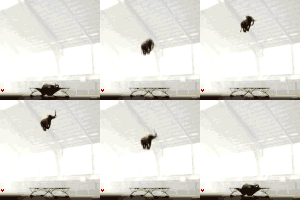
Here's one of my favourite pics:

Take this new knowledge into activities like squatting, sitting, and walking to integrate new ideas about particular joints within a more functional activity.
Landing on a kiteboard is basically just a matter of squatting a bit at the right time. Sometimes you'll be twisted, sometimes bending one leg more than the other, sometimes leaning further forward or backward. Experimenting slowly on land will help you find more efficient, safe and powerful ways of landing on the water, whatever board you ride.

 .
.

 ??? If the pads arent as good - I'll be buying another pair, no messing around now I know the difference.
 I am looking for something next season for big air and am thinking of the NHP but the Trax may also be the go....