Aluminium is the third most common element on Earth. It is mined as stuff called bauxite. Australia produces 33% of the world’s supply of the pure metal. Pure aluminium (called Aluminum in the US) is very soft and has little strength. It is used for pots and pans, as an outer skin for bitter fizzy drinks and lots of other things that are extruded. It is far too weak for use as a mast.
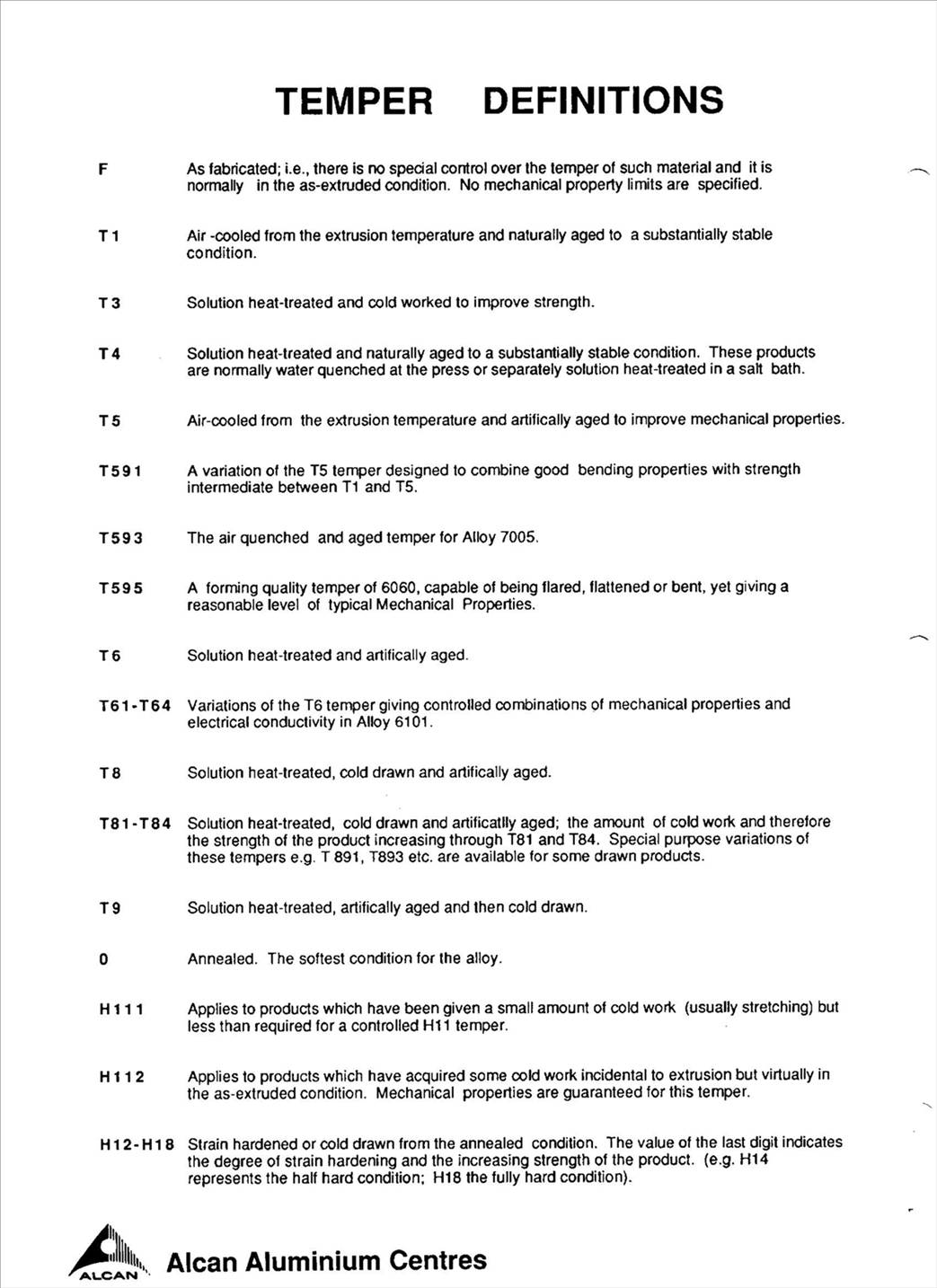
The metal we use for a mast is an alloy. An alloy is a mixture of two or more elements, eg. Brass is a mixture of copper and zinc, bronze is copper and tin. Steel alloys are very complex, eg, High Speed Steel (lathe tools, drills and cutters) contain iron, carbon, chromium, cobalt, tungsten, vanadium and a few other special elements. The aluminium for “Mast” alloys for our use may contain: silicon, magnesium, copper, iron, zinc and or a few other special elements to produce specific physical properties. Most aluminium alloys are known by an Alfa Numerical name, i.e. a number that may also include one or more letters. This number is a code that designates the alloy, the method of producing it and how hard it is. Hardness in aluminium alloys relates closely to strength and is known as Temper.
Basic temper is designated by the letters and subdivisions of letters and numbers. Eg:
-O Annealed, recrystallized
-H , H is always followed by two or more digits. The first indicates the specific combination of basic operations, eg.
-H1 Strain-hardened only
-H2 Strain-hardened and then partially annealed
-H3 Strain-hardened and them stabilized
The second number following (H1, H2, and H3) indicates the final degree of strain-hardening. The numeral “8” indicates a final degree of strain-hardening equivalent to that resulting from aprox. 75% reduction of area. Tempers range from “0” to “8”. The softest is 0, the hardest is 8. If the ultimate strength is halfway between these numbers (4), it is known as “half hard”. Some tempers are given a three digit number. The third digit indicates a variation of the two digit number. The minimum ultimate strength of a three digit type is close to that of a two digit type of alloy.
The letter “T” denotes that the alloy has been heat-treated to produce stable tempers with or without strain-hardening.
Alloys designated “T5” are artificially aged only: Applies to products which are artificially aged after an elevated-temperature rapid-cool fabrication process, such as casting or extrusion, to improve mechanical properties or dimensional stability, or both.
T6 alloys are solution heat-treated and then artificially aged : Applies to products which are not cold worked after solution heat-treatment, or in which the effect of cold work in flattening or straightening may not be recognized in applicable specifications.
T8 alloys are solution heat-treated, cold worked and then artificially aged: Applies to products which are cold worked to improve strength, or in which the effect of cold work in flattening or straightening is recognized in applicable specifications. (ref. “Machinery’s Handbook” edition 24, page 529)
The table at the bottom of the post may explain it clearer for you. (Ref, “Machinery’s Handbook” edition 24, page 538)
The specific characteristics of the alloys are arranged into numerical groups.eg.
1000 series have high corrosion resistance
2000 series contain Copper and require heat-treatment for optimum properties
3000 series contain Manganese and are generally non heat-treatable
4000 series contain silicon, lowers the melting point.
5000 series contain Magnesium, increases the strength of the alloy
6000 series contains silicon and magnesium. These added elements form magnesium silicide which makes the alloy able to be heat-treated. The major alloy in this series is 6061 being one of the most versatile of the heat-treatable alloys.
7000 series contains zinc and other elements. A notable member of this group is 7075 which is among the highest strength aluminium alloys available and is used for air-frame structures and highly stressed parts.
The following table is from Machinery’s Handbook edition 24, page 538
Alloy and Temper ..Ultimate Strength.............Yield Point
6063-0...................... 13 .............................. 7
6063-T1 ................... 22 .............................. 13
6063-T4 ................... 25 .............................. 13
6063-T5 ................... 27 .............................. 21
6063-T6 .................. 35 .............................. 31
6063-T83 ..................37 .............................. 35
6063-T831 ................ 30 .............................. 27
6063-T832 ................ 42 .............................. 39
The Ultimate Strength and Yield Point are given in "KPS".
I am not sure what “KPS” means. I think it is the old (?) unit used in the USA and means Kips Per Square Inch. A Kip is 1000 pounds (454.5kg)
Note: For all calculations, it is far better to use the Yield Point as the actual strength of the material. Yield Point is the point reached when deformation occurs, i.e., it bends or stretches beyond the point where it will no longer return to the original shape (or size) if the stress (load) is removed.
Kody