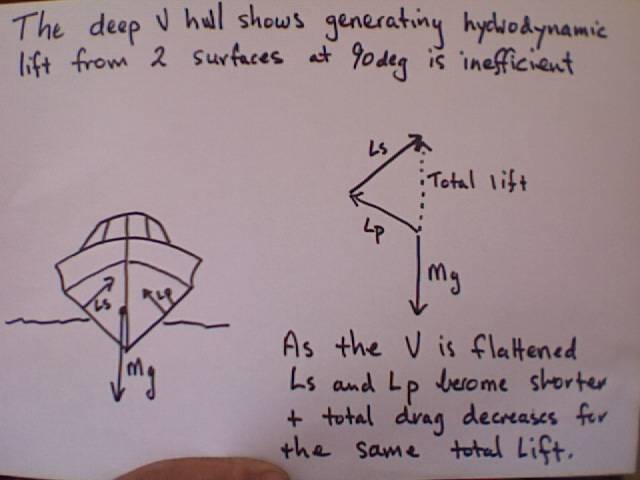
The new 50 cm rule got me thinking about one advantage of kite boards. Instead of dividing the required water lift into a vertical and a horizontal component as windsurfers do, kiteboarders use just one lift producing surface angled at the right direction. A bit of geometry shows that combining the vertical and horizontal foils into one inclined foil has a big drag advantage.
Suppose hypothetically you need 100 units of vertical lift and 100 units of horizontal lift . Assume for the exercise that the lifting foils/hulls all have a lift to drag ratio of 10:1. Using a foil, and a hull, each would have 10 units of drag for a total of 20 drag units. (diag 1)
One foil inclined at 45 degrees developing the sqrt ( 2 ) * 100 = 141 units of lift can do exactly the same job with only 14.1 units of drag. (diag 2)
The vector diagram with the fin canted to only 15 degrees still shows a significant drag reduction. (diag 3)
The double foil disadvantage is greatest when the two components are roughly equal and acting at the widest 90 degree angle. If you can't dispense with one of the foils altogether there are still advantages to be made by shifting most of the load to one or the other. In reality the board, which lifts against gravity, is working harder than the fin, so shifting a bit of lateral work to the board is one way - as kiters do. But on the other hand the fully submerged fin has a better lift to drag ratio than a planing hull so canting the fin windward and relieving the hull of some work may win out for windsurfers.
In the hypothetical example the fin at 45 degrees can lift the board just clear of the water, but that may be a bit much for a few reasons. You need a bit of board in the water for control, it's good to endplate the fin, it wouldn't work at all on the other tack,. A fin canted 15 degrees to windward would be worth a try. The vector geometry shows that for the hypothetical requirement of 141 units of lift at 45 degrees the total drag is 17.4 units vs 20 units for an upright fin. In the hypothetical example even a moderate 15 degree cant relieves the lift needing to be supplied by the board from 100 units to 68 units.
Formula boards have already achieved a degree of this effect by having very flexy fins. Sean O'Brien on the carbonsugar website describes formula fins as being flexy, and have the lift centre ahead of the twist axis. ie as the fins load up they don't flex off but load up even more. It appears that the lightening or unsticking of the hull as very noticeable with bendy fins, and they win races. A bendy speed fin preset to 15 degrees windward might incline to an even more favourable angle at speed and come back to 90 on the wrong tack for an easy ride back up the course.