I've had it in mind to build a sail from scratch but havent been game to cut into my roll of sailcloth.
when we were in Argentina , I was fortunate to meet up with Marcelo Alvarez from Foxtrot Velas.
Apparently there are only 6 sailmakers in South America, all in Buenos Aires. only 2 make landyacht sails. It makes you realize how lucky we are.
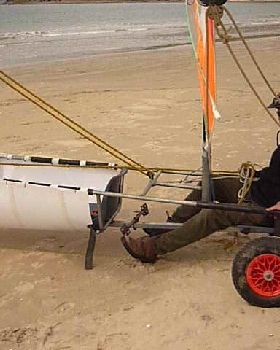
I bought a sail from him that is typical of European landyacht sails. It has a very straight leach and a high rounded head. I was very happy with the sail and on the salt at Lefroy it has sailed beautifully,fitting my local mast and promo CL5 very nicely.

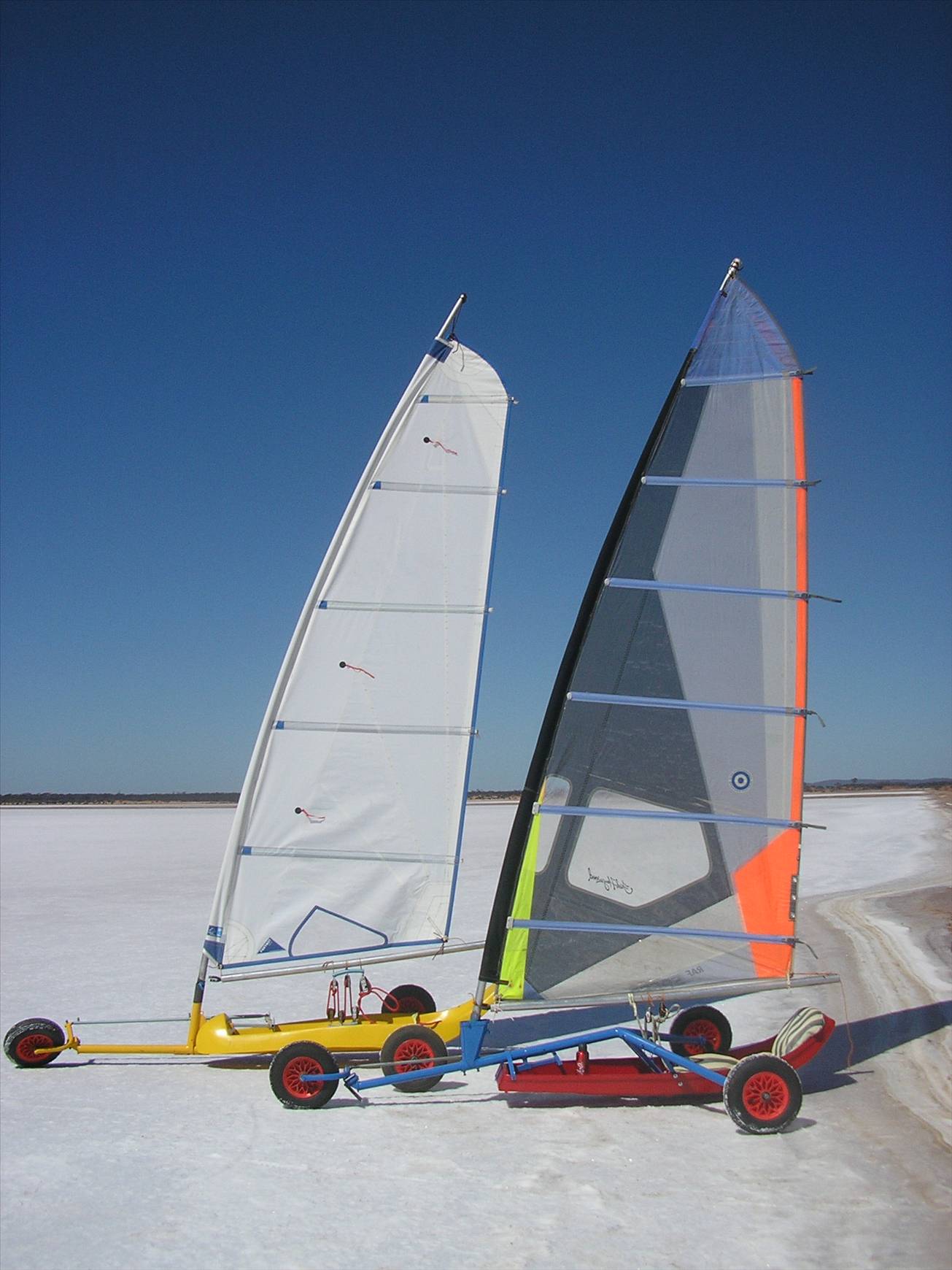
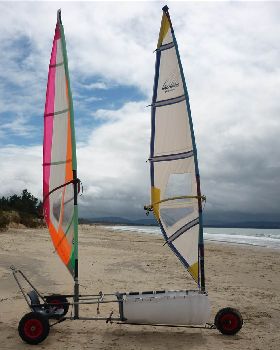
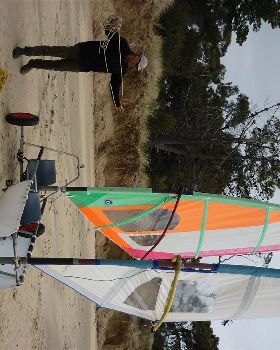
the sail on the left is the FOXTROT VELA it measures in at 5.15m( FISLY system).
sail on the right is a cut down RAF 6.5m that now measures in at 5.495m(FISLY system).
Marcelo was very happy to discuss the details of the cutting of the panels and the way the sail was created to take the shape that works.He was qute happy for a sailmaker in Australia to recreate the sail.
Given the cost of supporting a wife and 5 daughters put paid to the idea of letting a real live sailmaker loose on the sail, so why not try it myself

In S.Am. sail cloth is very expensive,so when a sail is first designed it is cut from POLYETHYLENE cloth that is commonly used throughout S.Am. for gravel and sand used in concreting. After a number of sails are tested the final design is built in Dacron/mylar.
in the meantime they have realized that the leftover poly sails are extremely tough longlasting sails, just what you want in the Southern Ocean.
The Sails we were supplied with for the WC08 were poly sails,and were not quite as good as the Dacron sails, but it made me realize that ,here was a great way to learn how to make sails without the material costs.
The top 4m of the sail profile has been transcribed to the floor of my cave and the rear panels adjusted to fit it.

the points are marked through the sail by poking a large needle through the sail and marking the concrete. I actually use a load of old screwdrivers,kichen utensils,etc which have been ground to a fine point. these will be used to mark the point onto the template material later.
Once the panel shape has been worked out on the floor ity can be tranfered to a set of vinyl templates. for this 4m sail I used4.5m of floor vinyl. luckily it came out of a rubbish skip. the piece as ALMOST big enough to redo the kitchen but I couldnt find a set of cupboards to go with it .
The rear panel, according to Marcelo were as you see them, ie all straight lines giving a large flat panel when sewn together. The curved shape in the sail is created by a 20mm even curve along the rear edge of the front panel.

.
this panel has had such a curve added to the template piece by bending a long glass batten on the vinyl.
Each vinyl template has had a 10mm seam added to those sides which will be sewn. the panels have been numbered on the floor of the cave as well as on the vinyl templates. also marked on the templates is the direction of the cloth.

2 hours of marking and cutting later and we have 16 template pieces all ready to go.
In the next post you will be scared and amazed by the source of my polyethylene cloth.
Life is just sooooo good