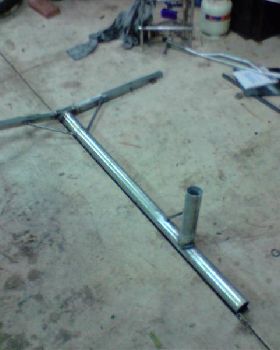
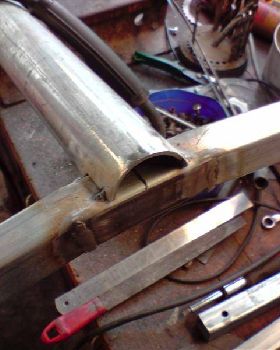
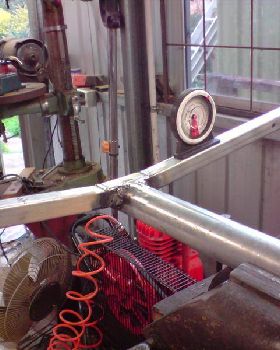
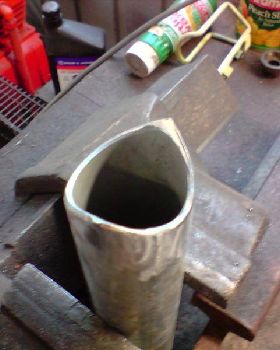
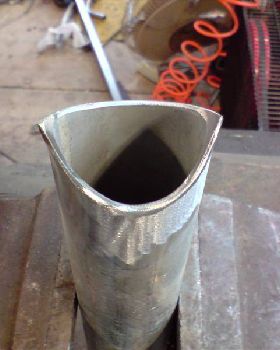
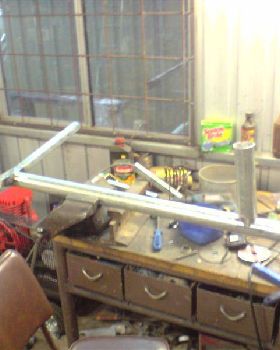
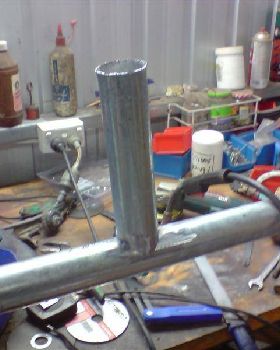
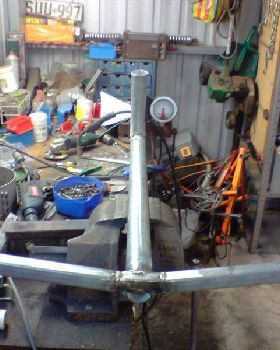
Introducing "Blue Flyer" and "Blue flyer II". Prior to sifting through the many posts on different mini front ends. I had a brain wave and thought a front mast pipe would be easier to make up than a spine mounted one. 76 Od pipe would give me some play when using the thick base aerial masts. Lots of grinding and filing to get it fairly square, weld it up and the front of the chassis is complete - steering and mast base. Three chain links were welded to the mast tube in lieu of a 3 way pulley block. An ex stop sign post is the spine and the back end is standard LLM.

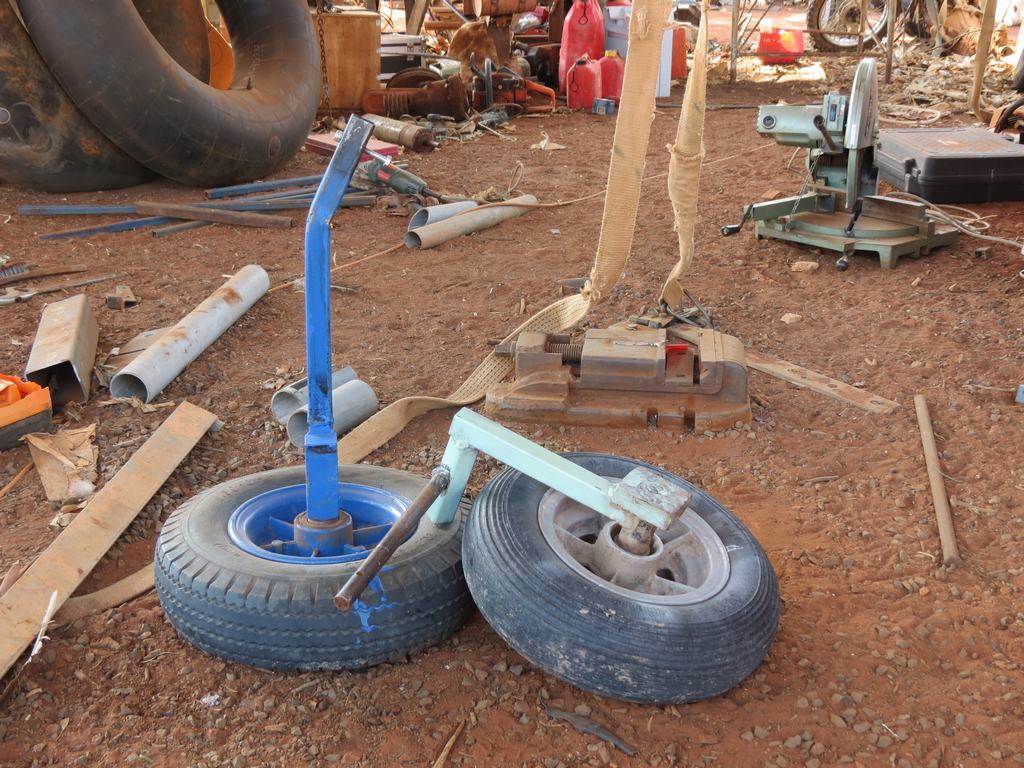
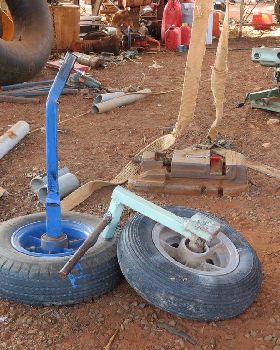
A 20" bike wheel and fork were set up to the correct angle. The headstem of the forks was heavier steel than I expected and welded easily. An 8" boat trailer wheel was also made up for a front end.

Test day 1 arrived and instead of getting a run it was ratted for the 20" front wheel to replace a collapsed steering arm on another land yacht and it donated both back axles and wheels to two separate landyachts that had clashed axles. It came back home with an odd pair of bent back axles.

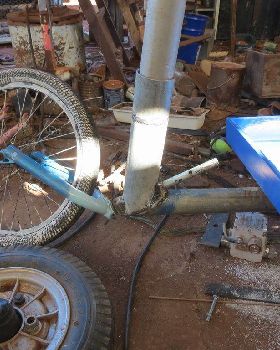
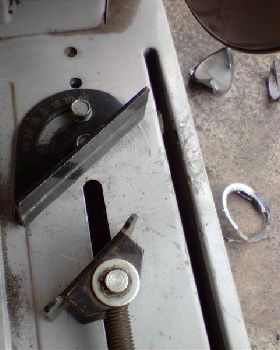
A two seater had been on the agenda for a while. One of the bent rear axles was able to be panel beaten straight and a 25mm tube was slid inside and welded in to beef it up. The other rear axle (in photo above) was too kinked so was cut off just below the bend and lengthened by about 400mm over original length. A length of 2mm wall 25mm RHS was ran full length inside the whole length.

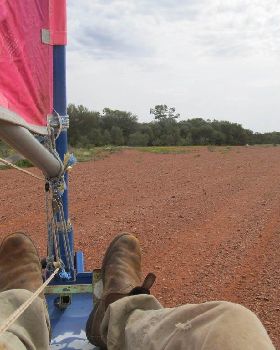
Test day 2 was more successful. A gusty northerly blowing down the local airstrip meant lots of 30 metre reaches were needed to work your way upwind. With short and long rear axles, the short side would tend to lift in gusts and the longer side tended to drift suddenly on the gravel airstrip. Steep spoon drains with bushes that had to be crossed when reaching added to the excitement. A tad less than 30kph was the top speed reached, the short runs across wind didn't give much time to wind up. What became obvious was the massive low down grunt the uncut 7.1 m2 sail had when allowed to belly out, able to pull me up the bank of a spoon drain over 3/4 inch gravel. Always able to sail back to the car in the 1.5 hours spent there. The back end felt really loose when gusts hit, lots of opposite lock needed to keep a straight line. Despite the corrugations, bushes and spoon drains the extended rear axle remained straight.

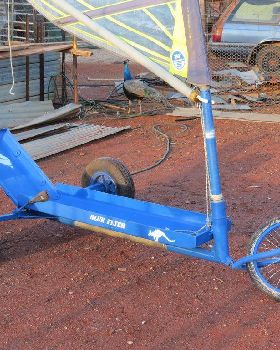
The extended axle and tandem seat spine

The only modification needed to any LLM is a lug welded on the chassis to pick up the front tandem chassis. The rear fits any standard LLM 35mm axle centre.

Test day 3, 7.30 am 20kph breeze The 11 year old pilots loved it. (and so did the older pilots)


The sail is not trimmed very well in the photo above. When sheeted in it took a good shape. The back end always felt skittish when a gust hit, The steering was pretty responsive and pulled the rest back into line unless you over corrected, then it fishtailed. Heading upwind you could fish tail all the way up the driveway using the low speed grunt of the sail to keep you moving. The easterly last Saturday meant we could use the main driveway, the trees on the west side play havoc with a westerly wind. For the first time ever we have officially gone faster than the wind. As recorded at the Bourke airport nearby Average wind speed for the morning 22 to 28 kph. Peak gust wind speed for the day was 37 kph. Michael and young passenger got it up to 45 kilometres per hour, Myself and young passenger only managed 42 kph and when the two heavyweights Michael and I did a run we got it to 40.8 (165kg). Strong winds expected this Saturday so might have to find a smaller sail, a pity, this sail mast and boom work so well together.





![P050609 15.41[02] (Medium)](/Img/Photos/Land_Yachting/tn/mini-2653155.jpg)
![P050609 17.42[02] (Medium)](/Img/Photos/Land_Yachting/tn/mini-2653188.jpg)
![P050609 17.42[03] (Medium)](/Img/Photos/Land_Yachting/tn/mini-2653190.jpg)