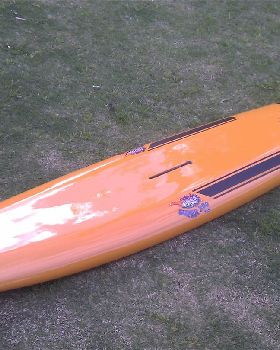
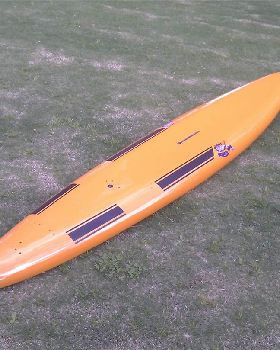
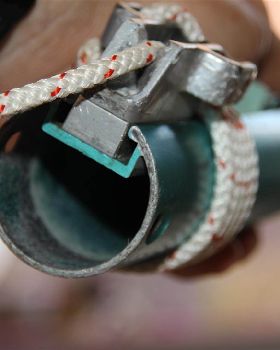
The original FangyFin was designed as a good all-rounder for use in shallow or weedy water. The performance is skewed toward providing strong lift and reliable handling, rather than a dedicated speed fin. So the next challenge for me was to design a FangyFin that has a lower drag,but retains some of the user-friendliness of the original.
The result is the FangyFin S. (codenamed Sid - after Sid Vicious) A FangyFin 22 was chosen as the test bed and my neighbours were treated to a sustained burst of angle grinding to get the foil thickness reduced. The first few versions of the fin were certainly slippery and exciting on the downhill and unsurprisingly, had a noticeable lack of bottom end power by comparison to the FF22.
The main problem was the handling was exactly as the project-name 'Sid Vicious' implies. This fin was a skinny and a rash piece of work and was guaranteed to have 'live fast and die young' feel. Overloading and aggressive feet easily induced spinouts, and overall, the fin was probably not much better than a Delta! The focus of the revisions was concentrated on making the fin more friendly.
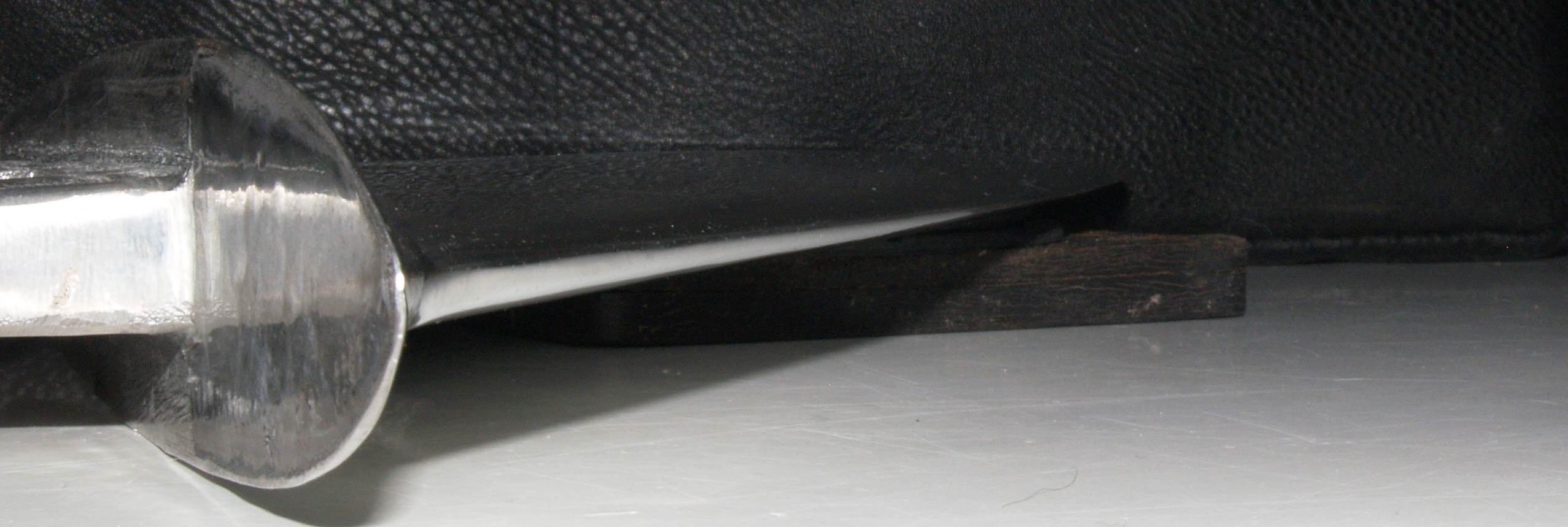
The earlier Selig inspired foil was slowly modified and the maximum chord moved aft. I did a chunk of reading on the effect of the merge profile between the leading edge radius and foil body and as a result, the nose section of the leading edge is relatively blunt and rounded, but transitions to a fine edge after the first third. I modified the fillet slightly to copy the strut fillets used on the AC yachts.

Next job was to have Nebbian 3D print it for me. Because you should always be Batman, Nebs went for the black print, which has the effect always making the fin look awesome. You can see the extended fore and aft fillet sections. The fillet edge is thick to allow for a nice cast surface in this area. The final product will have the fillet polished to a very thin edge. I also modified the box section to allow for easier bolt hole placement.

Nebs printed the fin in two pieces.

And then expertly joined them together.

For those who already have an existing FF22, I can email the foil outlines so that you can make templates and grind it back to a Sid Vicious version. But please note: when cutting back an existing hollow FF22, there is a chance the foil skin will be perforated as the existing hollow is not always perfectly centred. I would suggest filling the hollow with expanding foam first and then be prepared to glass over any perforations that might occur.


 Warning: Nerdy Bit follows. Go to Funny Images Thread Instead www.seabreeze.com.au/forums/General-Discussion/Chat/The-Funny-Images-Thread?page=432#lastpost
I have been investigating the possibility of an interaction effect of the fillet and non-slender, rounded leading edge Delta wing, ie a FangyFin. With the increased scientific interest in UAV's, the planform of a Delta wing has been morphing and is no longer considered to be an exclusively highly swept wing. The research literature now describes as little as thirty-five degrees sweep/rake designs.
The ideal Delta has a sharp leading edge bevel to induce the primary vortex. Theoretically, this occurs at leading-edge and produces lift as the vortex travels back over the wing. It is at its most efficient at relatively high angles of attack, eg. 20 -30 degrees. The more intense the vortex, the greater the lift.
With a sharp leading edge, the vortex initiates near the root of the wing. Cropping the wing tip of Delta wings does not affect the vortex formation. Extending the trailing edge on a cropped Delta wing provides a greater surface area for the vortex to act upon before it loses coherence. Example, Delta XT fins.
At lower speeds and lower angles of attack, there is a degree of traditional airfoil 2D like circulation. Hence Delta fins with higher chord thickness are easier to use at lower speeds but are comparatively 'draggy'.
A
rounded edge delta wing has several effects:
- reduces the primary vortex strength,
- delays the formation of the primary vortex,
- shifts the primary vortex origin out from the root toward the tip,
- increases the formation of a secondary(inner) vortex,
- creates a more stable primary and secondary vortex.
What follows are my educated guesses. I have no modelling or scientific analysis to add weight to my thoughts. Please do not view them as facts! I can provide the 3D CAD files should anyone wish to do a formal model analysis.
The FangyFin 22 Sid produces only moderate levels of low-speed lift due to the thinned 'low drag' foil shape. At higher speeds, the spanwise flow begins to dominate the fore aft-flows and the low-pressure area on the lifting surface begins to organise into a vortex structure and begins shifting toward the leading edge, and the fins behave more like a delta planform.
The stability of the fin is partly due to the stability of the flow from;
- initially, a foil shape that promotes laminar-like flow,
- at moderate speeds, the stable vortex generated by a rounded leading edge in the first third of the leading edge.
- the outer two-thirds leading edge transitions to a relatively sharp leading edge that is more traditionally associated with a delta wing and in turn promotes vortex formation. I think this might help account for the stability and retrievability of the fin with sudden increases in angle of attack/pitching in the chop, but I have no hard/modelled evidence to support this notion.
- at very low angles of attack, there is poor vortex formation, and this may account for a lack of 'feeling' from the fin when going too deep off the wind.
To summarise: The fillet provides less turbulence at the root. The rounded leading edge in the first span-wise third of the leading edge moves the vortex initiation toward the wing tip. I think the combined effect is to stop the primary vortex interacting with the pressure wave turbulence resulting from the board/fin junction and therefore reducing the likelihood of ventilation.
All I need now is some weedy water to speed test the fin in and see whether all my thinking is bulldust or not.