Windsurfers just don't get it!
The science of sailing is not rocket science. Sailing is more complicated. The maximum speed of a rocket powered car on a perfectly flat and level surface with no wind is limited by the total drag (aero + wheel resistance). The car reaches its maximum speed when the thrust of the rocket equals the total drag.
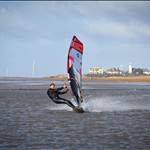
When sailing on a water surface, the maximum speed is never limited by the total drag because the thrust and drag are coupled. On the air side, both thrust and drag derive from the apparent wind flowing over the sail, the sailor and the board. The lift on the sail must be balanced on the water side by the lift generated by the board and its fin. Because the angle of the apparent wind is never zero, the thrust propelling the board is only a fraction of the lift generated by the apparent wind flowing over the sail. Under a small range of conditions the maximum speed of a windsurfer can be limited by the overall (L/D) resulting from both the air and the water side; where
1/(L/D)overall = 1/(L/D)air + 1/(L/D)water. When these conditions apply, it is important to maximize L/D on both the air and water sides. More often, however, windsurfer speed is limited by instability considerations.
In windsurfing vernacular, 'you spinout or capsize - and crash, dude.'
Kenney, B.C., 2001. Hyperwind Sailing. Catalyst, J. Am. Yacht Res. Soc., 6, 24-26.
Kenney, B.C., 2017. Hyperwind Sailing on Snow, Ice, Land and Water. Catalyst, J. Am. Yacht Res. Soc., 52, 4-18.