response of full carbon vs. 30% carbon masts
I'd always wondered about this claim, comes up all the time, just 5 minutes ago in another topic. So while waiting for the noreaster to pick up I've done some back of the envelope calculations.
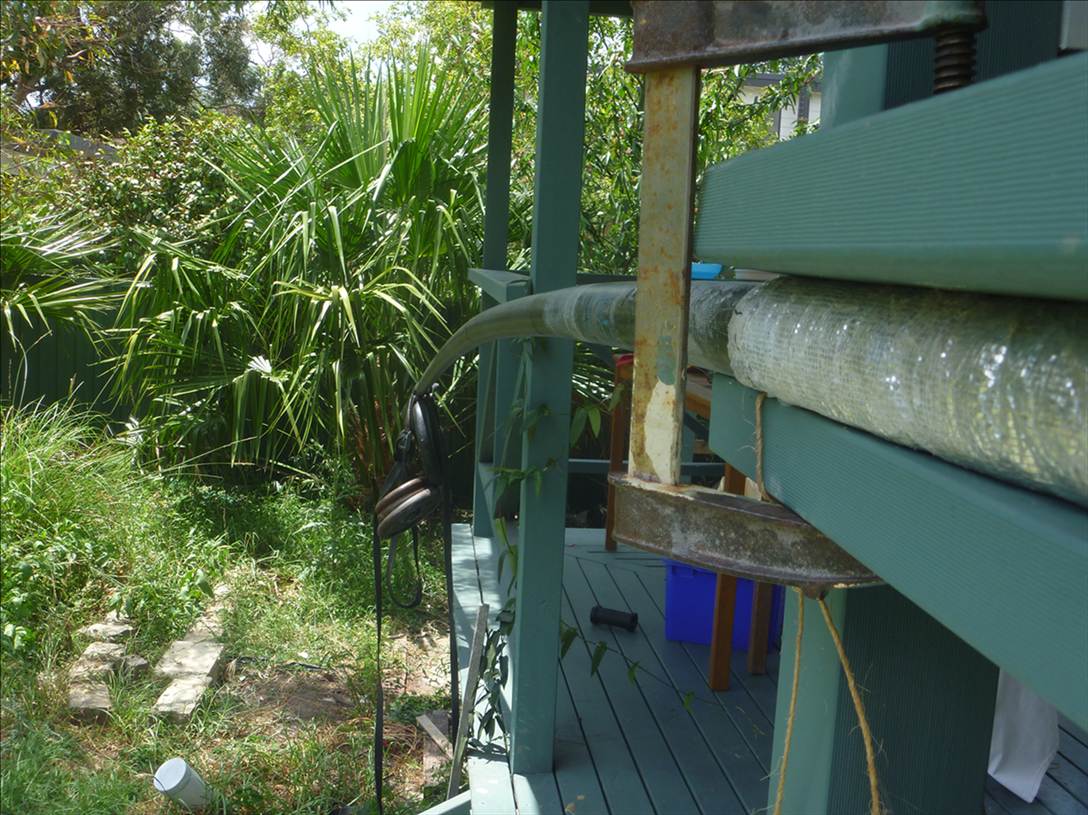
Got the old 30% NP 400 out, clamped it to the back veranda with the length above the boom ~ 2.7 metres hanging out. Loaded it up at the 2/3 out point, (900mm back from the tip) with 5 kg and measured the deflection. It was 60mm.
Now going to apply the equations for simple harmonic motion and figure out its oscillation frequency. Simple harmonic is normally applied to a spring working in a linear fashion with a non-rotating point mass rather than a bending beam with a distributed mass. The fundamentals are the same. I'm confident that using a centre of mass and "centre of spring constant" analogy will get us in the ball park. The calculations for a distributed mass are a bit frightening.
The mast from memory weighs about 3kg, the top 1/2 which is doing all the flexing probably weighs about 1kg. The sail centred on the flexing area weighs say 2 kg. Thats a 3kg mass oscillating on a spring with a spring constant of k = 833 newtons/metre.
For simple harmonic motion the oscillating frequency w = sqrt(k/m) = 16.66 radians per second. or 2.6 cycles per second.
A full carbon mast weighs about 2/3 as much so instead of (2 + 1)kg we put in (2 + 0.67 ) kg
the new oscillation period is 2.8 cycles per second
Not much difference. I haven't measured the "spring constant" of the full carbon mast because it should be exactly the same if the IMCS is the same.
What's that mean? Well you want the sail to keep up with the eddies passing the sail, flexing away and returning as one goes past. What's the smallest eddy that you might want a sail to respond to? I've gone for an eddy of dimension 1 metre. Any smaller than that and there will likely be a matching lull just below, the mast might as well do nothing.
Using Taylor's simple embedded eddy theory of turbulence a 1 metre eddy embedded in a wind speed of 10m/sec(~20 knots) will pass by in 1/10th of a second. The mast has to do a 1/4 oscillation cycle to return to its previous position as it passes. The 30% mast takes about 1/10 th of a second to do this naturally, so it should return without too much effort. The 100% mast can do a little better. But then again the back end of this embedded gust is only half a metre so should that be a 20th of a second?
All rough calculations, don't worry about the exact numbers. Larger gusts are probably of more interest and both masts have ample response to return after one passes.
Better mention that the simple embedded eddy model of turbulence is a little primitive these days, but it still serves the purpose for rough calculations.
These calculations have all ignored the damping component which will slow down the response. Maybe just a little bit, maybe a lot if the system is overdamped. Hard to estimate the damping component so haven't attempted any calculations. The air itself will contribute some damping. A lot could be contributed by the luff rubbing on the mast. Why do high carbon masts have a polished surface and low carbon ones a rough finish? Product differentiation?
Anyway I've concluded - It's surprising that sailors claim to notice an improvement in response with high carbon masts.
My 30% has a rough finish, my higher carbon smooth. Is this common? If so the damping component may be what sailors can feel. I can't tell the difference when sailing in a straight line for what that's worth.
View topic