julesmoto forum posts in last 60 days

julesmoto
julesmoto
NSW
1621 posts
NSW, 1621 posts
13 Nov 2026 1:38pm
Quixotic said..

garymalmgren said..
The wind powered ro-ro vessel has just completed a year of trans-Atlantic operation.
Think of the investment (and risk) that they were prepared to put into this thing.
Well done. I say
maritime-executive.com/article/wind-powered-ro-ro-neoliner-origin-proves-70-fuel-reduction-in-first-year
gary


Good on them. Here’s hoping they can prove it as commercially advantageous. Be interesting to know how the financials stack up and who the backers were, and indeed what the rig problems were. It’d be great if use of sails on commercial scale freight became commonplace. Back to the future say I!
And as an afterthought, I wonder if you could combine it with electric motors, batteries and prop based regeneration to do the end of trip, in-harbour manoeuvring?


Solar collector sails? Get Elon on the job.
julesmoto
julesmoto
NSW
1621 posts
NSW, 1621 posts
9 Nov 2026 3:56pm
Toph said

And these YouTube heroes that sprout their opinion as fact... please... I will give the video posted above some credit in that it was well put together and kept me engaged, but what is this blokes authority on the subject matter? Just because it is on the internet doesn't make it true.

I wish this topic would just get banned from this site once and for all.


FYI the guy James Evenson was a submariner in the US Navy and has sailed all over the Pacific firstly in a Spindrift37 cat that broke apart under him and then later in his oyster 485. His original YouTube videos are under the name Sailing Zingaro- US/Panama canal/Easter Island/Pitcairn/Hawaii and practically every place you can name that borders the Caribbean plus deliveries between the US and the med. I would rather be at sea with him than anyone else I know of. He is no lightweight YouTuber.
julesmoto
julesmoto
NSW
1621 posts
NSW, 1621 posts
2 Nov 2026 12:22pm
Thanks Gary.
In hindsight my request was very unclear.
I must have skimmed the video or been half asleep initially as I can now clearly see how and where it fits into the housing at about 8 minutes which is what I was after.
Good post. Thank you.
julesmoto
julesmoto
NSW
1621 posts
NSW, 1621 posts
1 Nov 2026 9:18am
Thanks, any pictures or videos of it fitted and in action?
julesmoto
julesmoto
NSW
1621 posts
NSW, 1621 posts
1 Nov 2026 5:18am
Yes I know that we have all heard of this 100 times or more and discussed it at length before but there are always new sailors buying boats and this is by far the best video I have ever seen on the subject with all relevant information in one place. The same guy- James- also did a video on the Benneteau that failed in the same way while he was doing a delivery but I think this one is better.
There is even new (to me) information here which I had never heard before and very good animations.

For example I had never heard previously that Benneteau chose to omit one of the keel bolts that the Farr design called for and I hadn't previously realised that the backing plates installed were so far out of spec. Also interesting from pictures (showing that some bolts snapped and some ripped through with their backing plates) that one may already have been snapped for some time having regard to a large rust stain on the bottom of the hull.
Once again so glad I don't have a European production boat or one that relies on an glued in fibreglass grid-especially a Benneteau.
The point about the boat's ePirb is also very good and tellingly this was also never deployed (for the same reason) when when that smaller Farr turned turtle off Wollongong a couple of years ago at night with the two young female sailors who were only found due to one having an Apple watch. When your keel snaps off there is NO time to do anything at all. It's instantaneous capsize.


julesmoto
julesmoto
NSW
1621 posts
NSW, 1621 posts
27 Oct 2026 10:47am
scruzin said..


julesmoto said..


scruzin said..


Kankama said..
Energy going somewhere is a good point - it is what car designers have to do. back in the bad old days, car makers didn;t want to know about adding safety features like crumple zones, safety cells, soft interior furnishings and air bags. In the end, the US government got around the industry's reluctance and the big car companies head in the sand mentality by stipulating that all government cars would have to have air bags. With such a big contract on offer, one of the big companies blinked and now we all have air bags.

Getting energy somewhere is pretty easy IF someone thinks about it. First, put a small crumple zone on the bottom and front of the keel, a crash box. Cats and tris have been doing something similar for decades. Newick even designed a crash box into his dagger cases. In my case the entire tip of the board is cut off and reglued back on. It broke off when I hit a rock at 7-8 knots - zero damage to the case. How much hassle to implement? Almost none. Weight, performance, build issues? None. Upside - I still have a boat, instead of a waterlogged cat with a case ripped through its bum. Tens of thousands maybe vs me in the shed with some cedar and glass.

A good fast cruiser could easily have a small foam/glass section at the front and bottom front of the keel - with a layup sufficient to slip it fine but with enough foam to cushion any 11.5 knot impact. All you need is to increase the time - doubling the time of stopping halves the force. It could be small and do a huge difference. As time of impact is directly proportional to distance - if the Oyster's keel deflected 1cm in the above example (lead deforming) and you put on a small 10cm crash edge, you would increase the distance by 10 times and reduce the force by something similar. At virtually no cost or hassle during the build. So the guys would still have a boat.

Also make that root long and add one extra tight but weaker than normal keel bolt at the front on the centreline. This one would take the initial load and break. Rock climbers have tight stitching that lets go on safety devices to reduce impact loads when falling. Its a oncer but it saves the boat.

I needed to make a new tip and glue it on my cat when I hit the rock at 7 knots or so. If my 500mm chord, 1.6m deep board, into a cedar and 600gm glass hull show absolutely no damage after hitting a rock when I was stupid, then a boat built like a brick dunny can also do it. You just have to do what I did when I built it. Think just a bit about what could happen and work a fix up.

Sparau - As for Leopards - no they are just dumb. To not dry out is awful in a cat and it causes issues when lifted. A yard near me doesn't lift some Lagoons because they put one on its kesl and it crunched and caused a court case. Considering it is really easy to build them properly, I can't understand it. Again there is no reason that an engineer couldn't do this - the builder just cant be bothered. As for Seawinds - you must have got bad one. Most sail pretty well and almost no Schionning has had a racey window designed in about 15 years - those days are gone thankfully.

I do shake my head at dumb design because, having built and designed boats, I know that you can make the boat better with a bit of forethought. It aint hard but it does require you to acknowledge the problem. The fact that any cruising keel falls off is a problem that can be fixed. It is just engineering and building, it aint hard.


Designing a bolt-on keel structure that can withstand a high-speed impact is extremely challenging. Because the impact point is 2m or more below the hull attachment point, the impact force is multiplied exponentially resulting in massive dynamic bending. I think it if it weren't such a hard problem, it would have been solved by now.

Of course, there is a solution, and it's an encapsulated keel that is structurally part of the hull. Or a multihull :-)


Apparently there was a racing Volvo 60 in around 2017 that hit a reef at full tilt-maybe 19 knots-and didn't lose it's extremely high expect ratio keel. Obviously it can be done. There is video and stills on the web. It happened at night-not that that is an excuse for the navigator. The keel continued to survive robustly on place the next morning by which time the rear of the boat and the rudders were toast.

Maybe they should cast a bit of flexible rigging wire into the keel and have it coiled up and secured to something strong inside the hull like an anchor rode is. That way the keel could still hang there holding the yacht upright although would probably still sink pretty rapidly from water ingress where the keel bolts were ripped out or the rear punched a big hole in the hull.
Wonder what the internal bracing was like on that Volvo 60 because it obviously can be done allbeit maybe at the cost intrusive structures in the center of the boat accommodation. Plenty of trailer sailers get by with accommodation intrusions such as floor to ceiling centre board cases however


I think you're referring to the grounding of Team Vestas Wind during the 2014–15 Volvo Ocean Race:

media.sailing.org/sailing/wp-content/uploads/2025/05/22163030/m36616_team-vestas-wind-inquiry-report-released-on-9-march-2015.pdf

If so, yes, they had a very well engineered and fabricated keel. Among other things, the keel was a single solid steel forging rather than cast iron or hollow composite.

So it _is_ possible.


Thanks for the link. There are other stills on the web and a video of the moment of impact taken from the rear of the cockpit that night.


julesmoto
julesmoto
NSW
1621 posts
NSW, 1621 posts
26 Oct 2026 11:42am
scruzin said..


Kankama said..
Energy going somewhere is a good point - it is what car designers have to do. back in the bad old days, car makers didn;t want to know about adding safety features like crumple zones, safety cells, soft interior furnishings and air bags. In the end, the US government got around the industry's reluctance and the big car companies head in the sand mentality by stipulating that all government cars would have to have air bags. With such a big contract on offer, one of the big companies blinked and now we all have air bags.

Getting energy somewhere is pretty easy IF someone thinks about it. First, put a small crumple zone on the bottom and front of the keel, a crash box. Cats and tris have been doing something similar for decades. Newick even designed a crash box into his dagger cases. In my case the entire tip of the board is cut off and reglued back on. It broke off when I hit a rock at 7-8 knots - zero damage to the case. How much hassle to implement? Almost none. Weight, performance, build issues? None. Upside - I still have a boat, instead of a waterlogged cat with a case ripped through its bum. Tens of thousands maybe vs me in the shed with some cedar and glass.

A good fast cruiser could easily have a small foam/glass section at the front and bottom front of the keel - with a layup sufficient to slip it fine but with enough foam to cushion any 11.5 knot impact. All you need is to increase the time - doubling the time of stopping halves the force. It could be small and do a huge difference. As time of impact is directly proportional to distance - if the Oyster's keel deflected 1cm in the above example (lead deforming) and you put on a small 10cm crash edge, you would increase the distance by 10 times and reduce the force by something similar. At virtually no cost or hassle during the build. So the guys would still have a boat.

Also make that root long and add one extra tight but weaker than normal keel bolt at the front on the centreline. This one would take the initial load and break. Rock climbers have tight stitching that lets go on safety devices to reduce impact loads when falling. Its a oncer but it saves the boat.

I needed to make a new tip and glue it on my cat when I hit the rock at 7 knots or so. If my 500mm chord, 1.6m deep board, into a cedar and 600gm glass hull show absolutely no damage after hitting a rock when I was stupid, then a boat built like a brick dunny can also do it. You just have to do what I did when I built it. Think just a bit about what could happen and work a fix up.

Sparau - As for Leopards - no they are just dumb. To not dry out is awful in a cat and it causes issues when lifted. A yard near me doesn't lift some Lagoons because they put one on its kesl and it crunched and caused a court case. Considering it is really easy to build them properly, I can't understand it. Again there is no reason that an engineer couldn't do this - the builder just cant be bothered. As for Seawinds - you must have got bad one. Most sail pretty well and almost no Schionning has had a racey window designed in about 15 years - those days are gone thankfully.

I do shake my head at dumb design because, having built and designed boats, I know that you can make the boat better with a bit of forethought. It aint hard but it does require you to acknowledge the problem. The fact that any cruising keel falls off is a problem that can be fixed. It is just engineering and building, it aint hard.


Designing a bolt-on keel structure that can withstand a high-speed impact is extremely challenging. Because the impact point is 2m or more below the hull attachment point, the impact force is multiplied exponentially resulting in massive dynamic bending. I think it if it weren't such a hard problem, it would have been solved by now.

Of course, there is a solution, and it's an encapsulated keel that is structurally part of the hull. Or a multihull :-)


Apparently there was a racing Volvo 60 in around 2017 that hit a reef at full tilt-maybe 19 knots-and didn't lose it's extremely high expect ratio keel. Obviously it can be done. There is video and stills on the web. It happened at night-not that that is an excuse for the navigator. The keel continued to survive robustly on place the next morning by which time the rear of the boat and the rudders were toast.

Maybe they should cast a bit of flexible rigging wire into the keel and have it coiled up and secured to something strong inside the hull like an anchor rode is. That way the keel could still hang there holding the yacht upright although would probably still sink pretty rapidly from water ingress where the keel bolts were ripped out or the rear punched a big hole in the hull.
Wonder what the internal bracing was like on that Volvo 60 because it obviously can be done allbeit maybe at the cost intrusive structures in the center of the boat accommodation. Plenty of trailer sailers get by with accommodation intrusions such as floor to ceiling centre board cases however
julesmoto
julesmoto
NSW
1621 posts
NSW, 1621 posts
21 Oct 2026 2:42pm
cammd said..
Probably still in the Whitsunday Passage


The stub
julesmoto
julesmoto
NSW
1621 posts
NSW, 1621 posts
20 Oct 2026 3:51pm
cammd said..


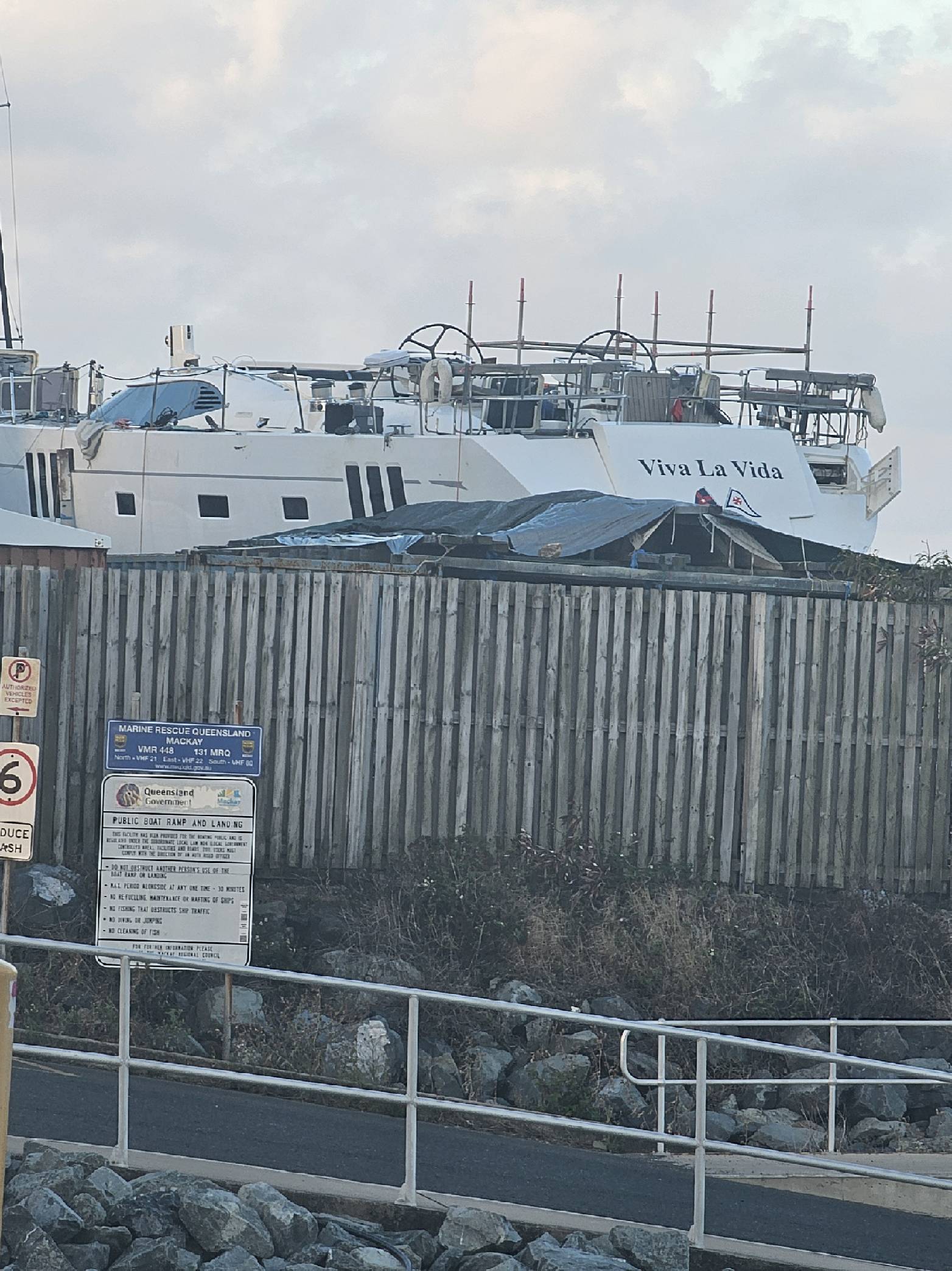
Pulled into Mackay today and spotted her on the hard as we were having a pizza for dinner.


Thanks for the pic. Shame the relevant bit isn't visible
Reply in Topic: Bommies
julesmoto
julesmoto
NSW
1621 posts
NSW, 1621 posts
19 Oct 2026 2:51pm
Toph said..
I couldn't care what was adopted as a safe standard, but currently in calm waters as I mentioned above, the current accepted rule of thumb is scope = 3 times the depth. If you come into a crowded or restricted anchorage, how are you to know someone has laid out 10 times the depth? That boat is swinging on an arc over a much larger area than the rest of the anchorage that's adopted a predictable rule of thumb, and in my opinion has become the danger.

If you are sailing in an area where that has never had to be considered then power to you, I am envious.


Never heard of 3x being safe. 5 to 7 more like it. I certainly wouldn't sleep anywhere on 3x.
julesmoto
julesmoto
NSW
1621 posts
NSW, 1621 posts
17 Oct 2026 4:04pm
Kankama said..
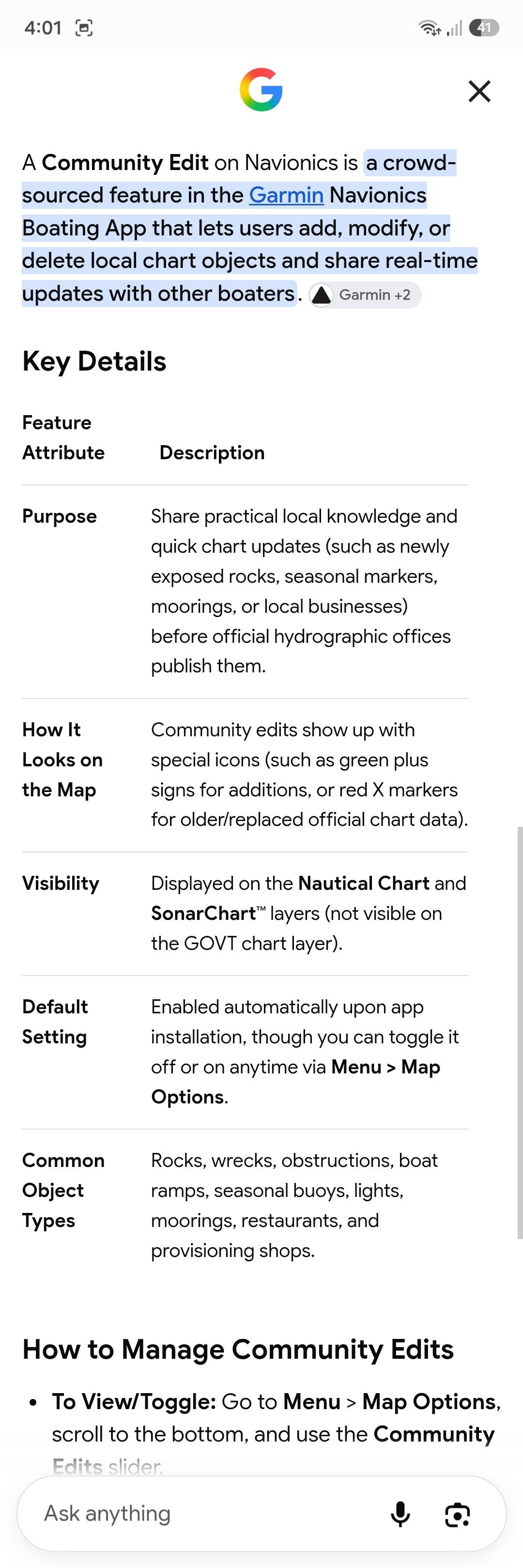
I don't have Navionics, but what is a community edit?


Did one once myself on Navionics when a reef was not where it was supposed to be on the outer Barrier Reef.

Also made use of a very useful one at 1770 last year where the sands constantly shift and hence the passage in. A local fisherman has marked the actual latest channel with a series of what looked like walking fisherman which confused me at first but saved me from running aground.


Reply in Topic: Bommies
julesmoto
julesmoto
NSW
1621 posts
NSW, 1621 posts
14 Oct 2026 9:59am
PacificStar said..
in the pacific we floated our anchor chain .

our friends irelene & brown on "Blown Away" explain how it's done here


this minimises damage to the coral and the chance to foul a bombie, but nothing can eliminate completely

cheers,


Chris 249 said..

julesmoto said..


PacificStar said..
in the pacific we floated our anchor chain .

our friends irelene & brown on "Blown Away" explain how it's done here


this minimises damage to the coral and the chance to foul a bombie, but nothing can eliminate completely

cheers,


Unfortunately this looks like a recipe for getting somebody else's keel, rudder or prop tangled in your chain


Plenty of experienced cruisers do it, so it seems to work.

Hope I never run into them with their concealed underwater hazard chain scores of meters from their boat
Reply in Topic: Bommies
julesmoto
julesmoto
NSW
1621 posts
NSW, 1621 posts
12 Oct 2026 1:33pm
PacificStar said..
in the pacific we floated our anchor chain .

our friends irelene & brown on "Blown Away" explain how it's done here


this minimises damage to the coral and the chance to foul a bombie, but nothing can eliminate completely

cheers,


Unfortunately this looks like a recipe for getting somebody else's keel, rudder or prop tangled in your chain
julesmoto
julesmoto
NSW
1621 posts
NSW, 1621 posts
7 Oct 2026 6:52pm
Get a delivery skipper ;)
julesmoto
julesmoto
NSW
1621 posts
NSW, 1621 posts
6 Oct 2026 9:09am
I've got a plb in my inflatable life jacket and I could probably wear it without a life jacket although I generally don't. I figure it's $400 well spent especially considering all the other exorbitant costs of owning a yacht and my advancing age. It's the ultimate plan b.

When I bought my yacht I didn't pay any attention to whether there was a swim platform or not and 99% of what I looked at did not have one. I came across an extremely rare ns38 which had a proper swim platform 18 inches long as a permanent extension to the hull and bought that particular boat for reasons completely unrelated to the swim platform. I now don't think I could do without one. It makes getting things on and off the boat from hey dinghy so easy including yourself and passengers. Obviously it has major advantages getting back on the boat if you are in the water and I would hate to be getting back on board without it. If you have the option then get a boat with one. My Clubman 8 trailer sailer also has an open transom. It may end up saving your life and also extending the age at which you are still capable to get on your yacht and sail. Not that I'm at the latter stage quite yet thankfully.
julesmoto
julesmoto
NSW
1621 posts
NSW, 1621 posts
1 Oct 2026 10:55pm
shaggybaxter said..
Sounds like a rudder let go and flooded the cabin. Man, I feel for him.


Fairly obvious point of weakness in a yacht so I'm of the firm belief that there should be a water tight bulkhead around that area.
My yacht originally did not have one but I installed one.
Interesting that it went down by the bow if the hole was indeed in the stern area especially considering the weight of the motor.